
Google's Getting Rid Of The Search Bar
(And other things we learned this week that make us want to lie down and take a beatr)
This Week In AI
Can we be terrified and obsessed at the same time? Asking for ourselves.
This week, Google announced that they're "getting rid of the search bar."
Cue the collective gasp. Cue the screenshots. Cue the LinkedIn carousels with seventeen slides about The End Of Search As We Know It.
Now if when you read that line, you pictured Google in your head, the page completely empty where the search bar used to be, a sad little Doodle just floating in the void... that's not exactly what's happening.
The change as we know it today.
The traditional Google search box (the one we've all been typing into for, oh, twenty-five years) is being "completely reimagined with AI." That's the actual phrase Google used. Instead of typing keywords or short phrases and getting a list of glowy blue links, you'll be able to ask Google the way you'd ask Claude or ChatGPT; full sentences, follow-up questions, the whole deal. And Google's AI will give you a synthesized answer at the top, not a list of websites to click through.
Between you and me, I've been typing full-on sentences into Google's search bar for over a year now. Sometimes I forget where I am and type the sentence into the URL bar instead and hit enter, and Google has wised up over the years and delivered me what I asked for even though I had no idea where I was. (Bless.)
So technically the bar is still there. What's dying is the list of blue links underneath it. (Kinda)
Now, some people are using the "search bar is dead" hook to scare you into action. We are not those people. (Gosh, I wish hopeful hooks worked as well)
We are not in the business of using fear to make you click a thing. (We're in the business of using slightly inappropriate honesty to make you click a thing, which is different.)
The blue links WILL still be there but they will be below the AI answer and we have already seen clicks on website pages go down 58% from AI generated search results.
Many people arn't scrolling beyond the AI Answer, especially now that in AI Mode you can continue to chat with AI to get the answer. They have also released Google Agents. Imagine looking up how to fix a broken toilet, AI Mode walks you through how, asks you if you want to call a plumber. Once you say yes the agent will find a local plumber and call them FOR YOU! (WHAAAT! Hello personal Assistant). For local service based businesses and even ecommerce this will be a huge plus, if you are prioritizing AEO to be the recommended business online. (Read more about the AI shoping experience here.)
If you are a personal brand, thought leader, and creator, you are going to want to make sure Google REALLY knows what you do, who you serve, and how you can help. Becuase while clicks are down 58%, citations inside AI answers are up 527%, Which means business right now that are winning are not ranking but they are being recommended!
Your business will still be findable on Google. But instead of being a blue link in a list, you'll need to be referenced inside the AI-generated answer. Which means the strategies we've been talking about for months around AEO (answer engine optimization), structured content, and being the authority Google's AI trusts enough to quote, just went from "smart thing to start thinking about" to "the thing you should really start doing." (Sorry to should on you this early in the week but we gotta.)
If you want an explanation of how AEO works compared to traditional SEO, we break it down in both of these podcasts.

Okay. Deep breath. Let's talk about what we actually did this week, because it's directly related.
Read Googles full release article
The Week We Got Obsessed With Our Own Data
Confessions from a woo-woo business owner.
For a long time, we ran K+C creative on what we lovingly call "vibes." (Vibes have gotten us pretty far. Our first $1,000,000 was made on vibes! So we do totally believe in it.)
But when you're solely trying to make business decisions on vibes, you start to second-guess everything and get overwhelmed because you're trying to put energy into too many things. When you're using data and metrics to help inform decisions and take action, life becomes like a fresh breeze under a shaded tree on a hot Atlanta day. A complete lifesaver.
We're trying to live our own advice, so this week we started logging into Google Analytics and Search Console every single day. Like a couple of stockbrokers watching tickers. And it's been exciting! (Also, daily is overkill so don't panic.)
(Quick sidebar: if you're sitting here going "wait, what's the difference between Google Analytics and Search Console?" — we wrote a whole blog post on the difference between Google Search Console and Google Analytics. Bookmark it. I'll wait.)
The first surprise was good. Our website is getting way more traffic than we realized. Which means all the podcast appearances and marketing we've been pouring time into is working. (We will be patting ourselves on the back later, thank you.)
But we also had a feeling there was more to the story. Like, sure, traffic is up. But are people finding what they came for? Are they sticking around? Where are we missing the boat?
So we did what we tell everyone to do. We asked our AI to help us figure it out.
How AI Turned A Pile Of Messy Data Into An Actual Plan
Every business has piles of "messy data" floating around. You probably have more of it than you think. Customer reviews. DMs. Comments on your social posts. Podcast transcripts. Years of email replies from customers. Your blog post archive. The captions you've written over the last two years.
It's all information. It's just sitting there in the abyss, unsorted, with no obvious way to count it or turn it into a decision. (The fancy name for this is unstructured data, but we don't need to get cute about it.)
And then there's the data that already lives in rows and columns. Your Google Analytics. Your Search Console. Your sales numbers in Kajabi. Your email open rates. (The fancy name for this one is structured data. Again, not important.)
Both kinds are overwhelming. Both kinds get ignored. Both kinds contain answers about your business that you just can't see because there's too much of it and not enough of you.
This is the part where AI changes the game. (I hate that I just said "changes the game" but we'll let it stand because it's true and sometimes I feel like I'm a literal character in this game of business.)
You can take any of this stuff and hand it to an LLM (like Claude) and say "read all of this and tell me what's in it." Like:
- "Here are 200 customer reviews. What are the top five things people love and the top five complaints?"
- "Here are my last 30 Instagram captions and the engagement on each. Which topics performed best?"
- "Here's a year of customer support emails. Categorize them by issue and tell me what comes up most."
- "Here are 10 post-project client surveys. Where do we need to improve?"
- "Here's my Search Console data. Find me pages getting impressions but no clicks."
That last one is exactly what we did this week.
The 1,300 Impressions And Two Clicks Situation
Our One-Page Website in a Day® sales page (one of our favorite entry-level offers, the one we want every single small business owner to know exists) had been shown to about 1,300 people searching for some version of "website in a day" on Google.
Two people clicked.
TWO. or .1%
That is, mathematically, almost zero people. That is a rounding error. That is the algorithm equivalent of a polite cough.
We've been making content. We've been doing podcasts. We've been showing up. And meanwhile, this page that's perfectly designed to help the exact people who are literally typing "website in a day" into Google, is being ignored. Like a beautifully wrapped gift under a tree no one's opening.
Claude looked at the data and basically said, "Hey, your title and meta description aren't matching what people are actually searching for. Google understands it's a fit for them but they are NOT connecting the dots because of how you have it titled.
So we rewrote it. We made the title and meta description lead with exactly what someone searching "website in a day" is hoping to find. We did this in about 10 minutes total, from opening Search Console to pasting the new title into Kajabi.
Ten minutes.
Without AI, this probably would have been closer to an hour. To find all the missed opportunitites Claude pointed out. It came back with a whole list of pages that needed attention, and data points we could use to make a bigger marketing impact. The "website in a day" page was the biggest one with the lowest hanging fruit. We never would've found all of them in one sitting on our own.
The data on whether the new title actually works is still cooking. We'll report back in a future issue. But the take away is already clear, and that's that sometimes the highest-leverage thing you can do for your business this week isn't making new content. It's going back and fixing what you already have. (Read that line ONE more time and shout it to the people in the back!)
Real Talk from Real Business Owners
Before you go login to your own Google Analytics and ask Claude to fix your life, we need to tell you something important.
You need to set goals first.
If you walk up to Claude and say "look at my analytics and tell me what to do," you're going to get a generic, surface-level overview that will have you chasing a goal you didn't set. And making decisions without a goal to anchor them in falls back into vibes land. Which defeats the whole point.
But if you walk up to Claude and say "I want to drive more clicks to my entry-level offer pages, find me the biggest gaps," or "My goal is to make $10,000 every month. I have these three offers — what are you seeing that will help me scale them in the next six months?" you get a strategy and a real plan.
The AI is only as smart as the question you bring to it. (We say this approximately seventy times a week, but it bears repeating.)
So before you dive into the data, get clear on what you're actually trying to figure out. Are you trying to drive more email signups? More sales of a specific product? Better engagement on blog posts? Pick a goal. Then ask the question.
What We're Doing Next (Because We're Extra Now)
Now that we're officially Data People, I'm setting up my Claude coworker to run weekly and monthly data reports for us automatically. (Yes, my Claude coworker has a name. I call her KIKI.)
The idea is that every Monday morning, instead of us logging in and digging through dashboards, we get a structured report telling us what changed, what's working, what's slipping, and what to look at this week. Set it up once, get insights forever. A new assistant was just born from a scheduled task in cowork.
This is also one of those classic "things you didn't start your business to do" tasks. You didn't open up shop because you were passionate about analyzing click-through rates. You opened up shop because you wanted to help people transform their health, or teach them what you know, or sell the thing you spent years perfecting. The data part is just... what comes with the territory of building a real business. (Welcome to the Hat Club, where you wear many, even the ones you don't want)

P.S. Last time we were in San Miguel de Allende, we saw you and took a picture of you wearing all the hats you now have as a business owner.
Don't feel bad... most small business owners never look at their analytics. Not because they don't care, but because it's overwhelming and confusing and they have approximately seventeen other things on fire. So they keep making decisions on vibes alone, and they never know what's actually working.
Well, if AI can put out one fire for us today, it's gonna be that one. We don't want it to replace your judgment. We just want it to do the data wrangling so your judgment has something real to work with. And then you can bring back the vibes WITH the data to make the BEST decisions.
You Can Try This Too
Here's the simplest version of what we did, that you can do this week.
- Open your Google Search Console. (Not sure what Search Console even is, or how it's different from Google Analytics? Read Google Search Console vs Google Analytics: What's the Difference before you go any further. It'll save you a lot of confusion. If you don't have Search Console set up yet, that's step zero. Google it. It's free.)
- Look at the "Performance" report.
- Find pages with high impressions but low clicks. Those are your missed opportunities.
- Take a screenshot or export the data. Drop it into Claude with this prompt: "Here's my Search Console data. I want more people to click through to [specific page or offer]. Find me the biggest opportunities and tell me what to change."
- Make the changes. Wait two weeks. Check again.
That's it. That's the whole strategy.
If you want to get even fancier and connect your Analytics directly to Claude so it can run reports for you automatically, that's a setup we'll walk through in a future issue. (Yes we're teasing it. We learned from the best.)
From Our Desk
Here's what this week taught us, again and again.
The businesses that are going to thrive in this new AI-powered internet aren't the ones with the biggest budgets or the loudest marketing. They're the ones who actually look at what's working and adjust. The ones who know how people are finding them, what's getting them in the door, and where they're losing people on the way to checkout.
Most business owners don't do this. Not because they're lazy. Because data is boring and analytics dashboards were clearly designed by people who hate small business owners. (I said what I said.)
AI changes that. The data is still there. Now there's just a really smart thing standing between you and the spreadsheet, willing to do all the boring parts and hand you the meaning.
If Google really is changing how we get found, we want to be the people who actually understand how that's happening for our business. Not guessing. Not vibing. Knowing.
(Okay, vibing a little. We're not animals.)
See you next Sunday.
XO Krissy + Claire
BONUS | For AI Club Members
AI Club members Get 30% off the Blog Writing Skill + Schema Markup Creator in the AI shop.
The Goal Setting + Data Scoreboard Prompt: This prompt is going to help you set one clear quarterly goal for your business and build the simple scoreboard that proves whether it's working. Three KPIs. Ninety days. That's it. Pair it with the Profit Margin Multiplier Prompt from Issue 9 and you've got a real system, clear goal, clear metrics, with clear highest-leverage tasks.
 The AI Advantage
Been worring about designing your Author or Speaker website?
We are here to SAVE you from yourself and the land of endless design decisions!
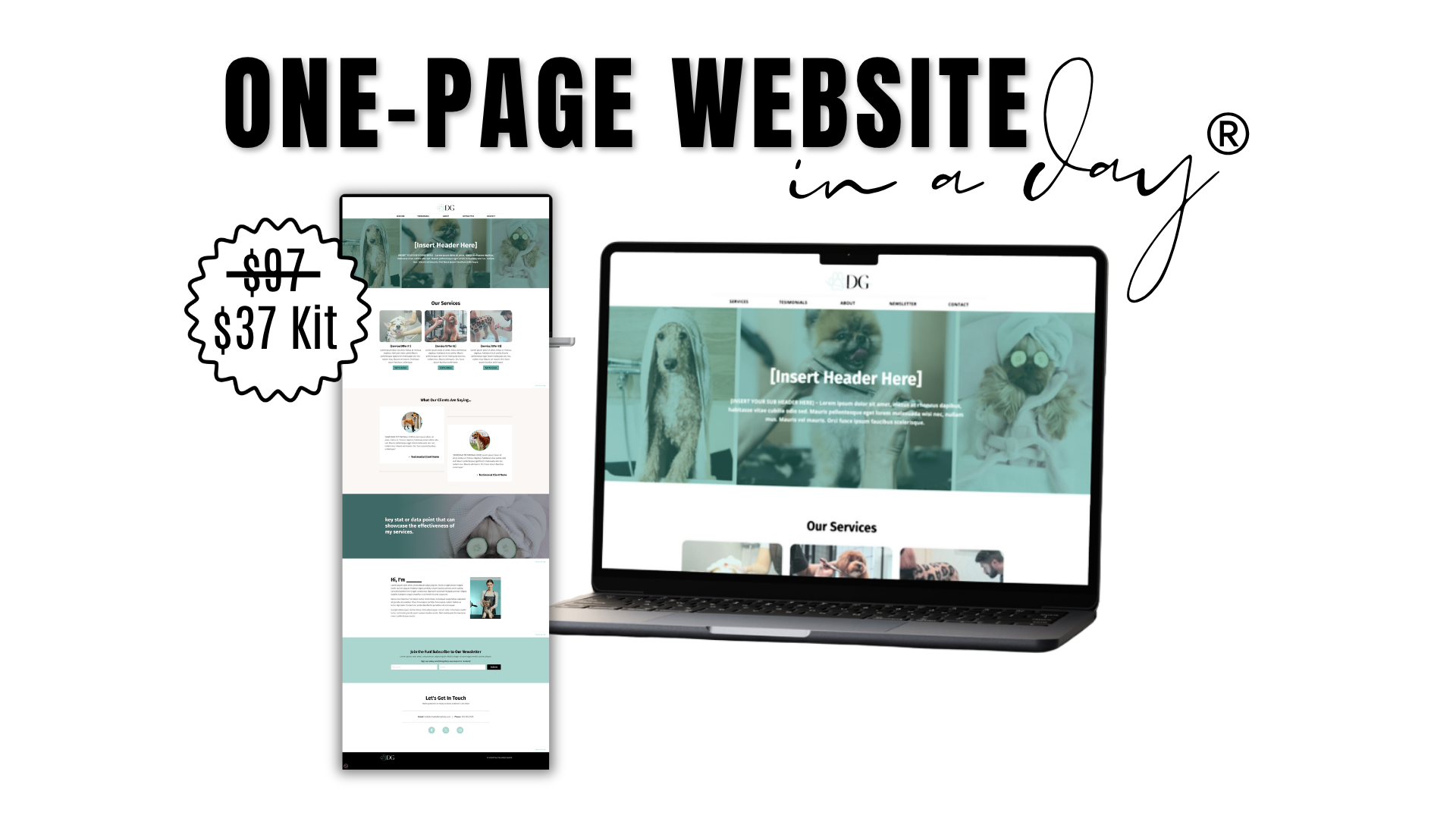
The One-Page Website in a Day® Kit gets your website live today, without writing a word of copy or making a single design decision so you can start building your email list and promoting your offers.
(Perfect for personal brands too!)
YES! Make my life easier PLEASE!
Join Our Free Trial
Get started today before this once in a lifetime opportunity expires.