THIS WEEK IN AI
The Way People Find Information Just Changed. Here's What That Means for Your Marketing.
This week, we noticed something BIG. Something that has quietly shifted over the last few years but we are now seeing how it's impacting not just our business but yours too.
For years, whenever we had a question about anything, the move was automatic. Open a browser, type in a few words, scroll through a handful of links, and piece together an answer. Google was just the thing you used. So much that it turned into a verb! For so long, we would casually say, "Google it." It became the default for finding information and answers.
That habit is changing. And the numbers are proving it so.
More than one-third of consumers now start their searches with AI tools instead of traditional search engines. And Google, which used to be where nearly three out of four people went first when they wanted to learn something or answer a question, has watched that number drop to just under two out of three in the last six months alone. That's its biggest decline in years. Gartner (a large research and advisory firm that companies pay a lot of money to for data, forecasts, and industry predictions) is predicting that overall search volume will drop another 25% by 2026 as more people shift toward AI assistants. Neil Patel, one of the most well-known names in digital marketing, sent an email this week pointing out that even paid search is feeling it. The cost to run ads is up, the number of people actually clicking on them is down, and it's not because the campaigns got worse. It's because AI is answering the question before people ever get to the ad.
That last one is the part we can't stop thinking about.
Because we know that most people still don't fully trust AI. A global study of 48,000 people across 47 countries found that while 66% are already using AI regularly, less than half are actually willing to trust it without verifying somewhere else first. Only 5% of Americans say they trust AI "a lot" for information.
We experienced this exact thing this week, and it had nothing to do with business.
I'd always cooked salmon at 400 degrees, roughly 10 minutes per inch, which is what I'd heard (somewhere) so long ago. We kept overcooking it. So this time, instead of Googling like I normally would, I asked Claude. It told me to cook it at a much lower temperature, somewhere between 150 and 225 degrees, low and slow, to keep it moist.
My first reaction was, "What? That can't be right! It is SO far from what I thought!" And AI has done me dirty before, not giving me the right information. So I immediately went and pulled up a few blogs to double-check. And every single one of them said the same thing Claude did.
The salmon was delicious, for the record.
But what happened in that kitchen is exactly what's happening with your potential clients every single day. They ask AI first, and then they go verify with a real source. Which means your content, your blog posts, your website, the expertise you've been putting out there, it's still the thing people are looking for. It's just that now AI might be the one sending them to it. OR even better, you help validate the information! Which sounds counterintuitive, but when your content is the thing that confirms what AI already told them, it actually makes them trust you more.
OPINION
You Don't Have to Choose Between SEO and AI. You Have to Do Both.
Here's the take we keep coming back to, and it's a little more nuanced than what most people are saying right now.
A lot of the conversation around AI search sounds like "SEO is dead, optimize for AI now." And a lot of the pushback sounds like "Google still dominates, don't panic." Both of those things are technically true and neither of them is actually helpful because it leaves you lost and confused on what actually works to market your business.
What we think is actually happening is this: the people who are going to win at marketing over the next few years are the ones who don't abandon what's been working and layer the new strategies on top of it. Not either/or but both.
Search Engine Journal put it really well when they said that SEO has never been more important for being discovered in AI tools, because the foundation is the same: clear, structured, credible content that actually answers a question. The basics that made your website findable on Google are the same basics that make your content citable by AI. The difference is in how you write it and how you structure it.
And that's where SEO, AEO, and GEO come in.
SEO (Search Engine Optimization) is what many have been doing for years. It's built around keywords, the words and phrases people type into a search bar, and the goal is to rank on Google.
AEO (Answer Engine Optimization) is about showing up in AI-generated answers. Instead of optimizing for a keyword, you're optimizing for a question. The goal isn't just to rank, it's to be the source an AI tool pulls from when someone asks something in your area of expertise.
GEO (Generative Engine Optimization) is the broader practice of making sure your content is visible and credible across all AI-generated responses, whether that's ChatGPT, Claude, Perplexity, Google's AI Overviews, or whatever comes next.
The biggest difference between SEO and AEO comes down to intent. SEO is optimized for a click. AEO is optimized for being the answer. And we're in a moment where both matter.
We've talked about this in depth on two different podcasts recently. We joined Ellen Yin on Cubicle to CEO to talk about how to get AI to recommend your website, and we sat down with Emily Reagan on The Marketing Freelancer to break down how SEO and AEO work together to drive more traffic. If you want to go deeper on any of this, both episodes are worth your time.
Here is the full blog that covers all three, SEO, AEO, and GEO, in one place.
One more thing before we move on, because we'd be doing you a disservice if we didn't say it. AI is not a perfect oracle. My sister asked it a question about the current pope and it named one who had already passed away. We asked it to calculate 500,000 times 160 and it told us 80 billion, then insisted it was right. It's actually 80 million, by the way. The point isn't that AI is bad or unreliable; it's just that it's still a tool, and like any tool, it can make mistakes. The people verifying AI answers with real content are going to keep landing on the websites and blogs of people who actually know what they're talking about. Make sure yours is one of them.
HOW TO USE AI THE RIGHT WAY
No Time to Blog? No Idea Where to Start? AI Fixes Both (and you won't get shamed for using it the right way.)
We want to say something that's going to be a little uncomfortable, because we think it's the most important thing in this entire issue.
If you are opening Claude or ChatGPT, typing "write me a blog post about [topic]," and posting whatever comes out, you are not using AI the right way. And it's quietly working against you in ways you might not see yet.
When AI writes without your input, it's not pulling from your experience. It's not using your client stories, your specific perspective, the things you've learned the hard way, or the opinions that actually make you different from everyone else in your space. It's pulling from everything it's ever been trained on, which means it could easily be pulling from your competitors, from generic articles, from surface-level takes that have nothing to do with what you actually know and believe.
The output might sound fine. It might even be technically accurate. But it won't sound like you, it won't carry your perspective, and it definitely won't be the reason someone chooses you over the ten other people saying something similar.
The goal was never to have AI come up with your content. The goal is to have AI organize and structure your knowledge so one, it saves you time, and two, it actually gets found by the people looking for what you know.
Think about what we used to do at K+C creative. We were paying $1,000 every month to have someone write four blog posts and four marketing emails for us (because I didn't have time). And those pieces, even with a professional writer behind them, didn't incorporate our actual stories. They didn't reflect what we'd learned from working with our specific clients. They were good, but they weren't really ours. And they definitely weren't written with AI search in mind, because that wasn't even a conversation yet.
So we built something that solved all of it at once.
Our Blog Writing Skill and Schema Markup Creator, where Claude interviews you before it writes a single word. It pulls out your real experience, your perspective, your client stories, and the things only you would know, and then it writes your blog using the framework we developed specifically for this moment in marketing, one that's built to get your content found by both Google and AI tools. If you've been wanting to blog but never have the time or aren't sure where to start, this is the answer to both of those problems.
Instead of $12,000 a year like we were spending, you invest $67 one time and have a blog writer on your team that is skilled in writing blogs for AI tools!
AI Advantage members get an exclusive discount code in the extended newsletter. Not a member yet? Join for just $5.55 a month and the code will be waiting for you at the end of this newsletter.
If you read Schema markup and thought "Schema what?" you are not alone. We didn't add it to our blogs for years, because we didn't know we should!
Schema is the behind-the-scenes code that tells search engines and AI tools exactly what your content is about, who wrote it, and why it's credible. It's one of the clearest signals you can send that your content deserves to be cited and recommended. The Blog Writing skill generates it for you automatically at the end of every post so you never have to think about it. (We also have a free standalone Schema Markup Tool if you want to use it on content you've already published.)
You can grab the Blog Writing Skill and Schema Markup Creator in our shop HERE.
And if you want to go even deeper (including how to come up with your blog topics) that's what we're covering in the paid section of this newsletter.
THIS WEEK WE USED CLAUDE FOR
A Running List Of How We Used AI This Week
Used it for both work and personal projects this week!
Krissy:
Co-wrote two blog posts. The ideas, the opinions, the direction were all mine (thanks to the pre-interview, our Blog Writing Skill does). But Claude helped shape the structure and write it in the proper format. Both posts together took about an hour. Writing them solo would have taken closer to four. (Saved approximately 3 hours)
Asked Claude to help design a small bathroom remodel. Uploaded a photo, explained the space, and asked what could make a small bathroom feel bigger. It came back with layout suggestions, fixture ideas, and design tips that actually made sense for the room. Was it a licensed contractor? No. Was it a free? Yuppers. (Saved the cost of a design consultation)
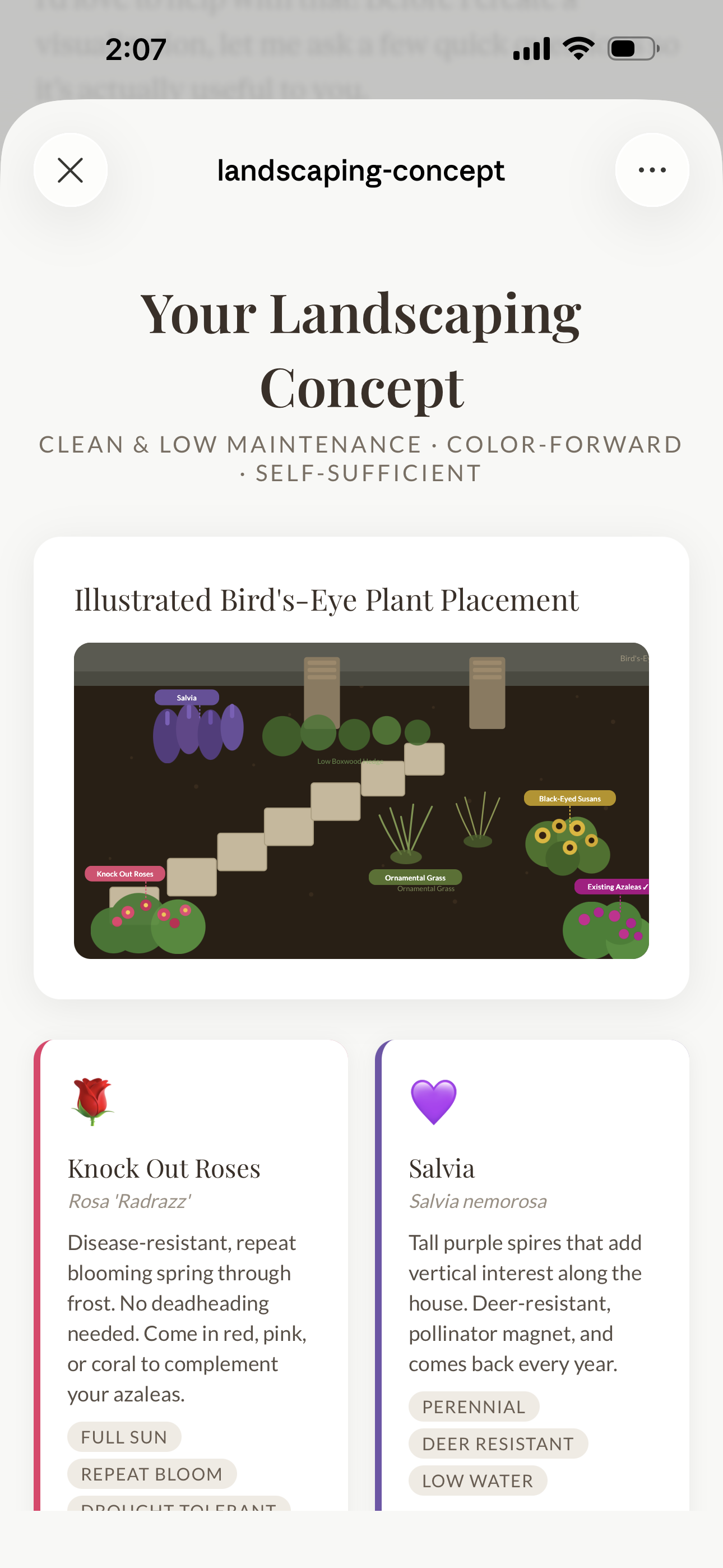
Tested Claude vs. ChatGPT for landscaping ideas. We uploaded a photo of the yard and asked both tools for help with planting ideas. Claude came back with a detailed illustrated bird’s-eye diagram, labeled plants, care notes, and sun requirements. Definitely helpful for planning.
ChatGPT actually brought the vision to life by creating a photo-realistic rendering of the exact yard with the plants already in place. It may have made the space a LITTLE bigger than it actually is, but it gave me an idea of what it could really look like in real life, which is a completely different experience.
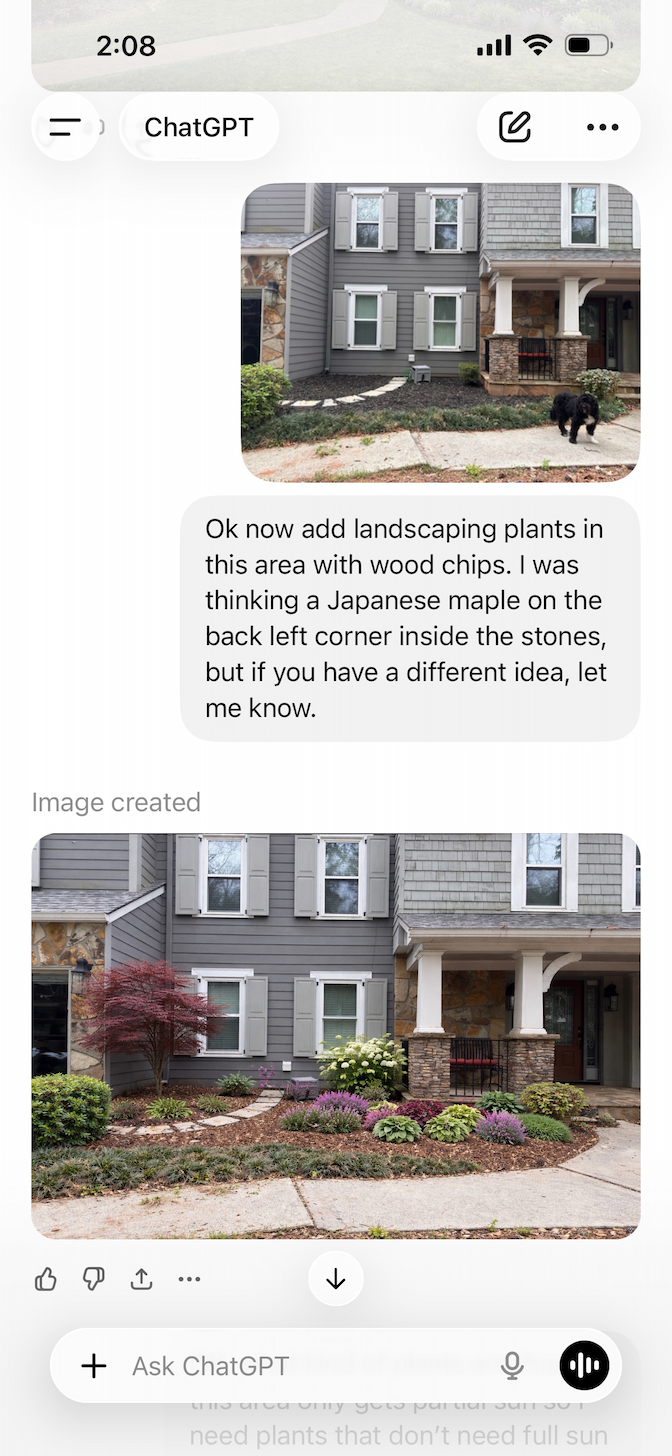
If you need photo-realistic renderings, ChatGPT is going to win that one because it uses DALL-E to generate images.
Tried to get Claude to generate logo and icon ideas for the new name for this newsletter! (Coming next week) This did not go the way I hoped. About 20 minutes in, we realized Claude just wasn't going to get us there. As a non-designer, I didn't give it much direction, and Claude wasn't coming up with anything amazing. Which proved that you need to give it creative direction to get something great (if even possible yet)! We'll leave this one to Claire! (20 minutes to learn a valuable lesson)
Claire:
Used Claude to code an FAQ accordion section in Showit. The FAQ opened and closed exactly the way she wanted. It looked great. And then she noticed that when a question expanded, it covered the content below it instead of pushing it down. This was not gonna be a done as better than perfect moment. Especially not for a client website! She spent 20 minutes troubleshooting with Claude before realizing this was a Showit limitation, not a code problem. She ended up building the FAQ from scratch the traditional way, which took about 3 hours. (Yup, this is why it's a big investment for a done-for-you website and why sometimes it's super frustrating to DIY! Sometimes AI gets you 80% of the way there, and the last 20% is a wall. (Saved nothing on this one. Infacted wasted 20 min, but now we know)
Overall, this week was a little less epic with a lot of AI roadblocks, but we learned a lot and will keep exploring ways to work more efficiently.
BONUS | For AI Advantage Members
Writing Blogs for AI Is a Completely Different Strategy. Here's How To Do It.
Writing blogs for AI is completely different than writing blogs for SEO. In the extended newsletter, we break down exactly how the strategy is different and hand you the prompts to walk away with your next 20 blog topics ready to go.